
⚠️ This blog post was created with the help of AI tools. Yes, I used a bit of magic from language models to organize my thoughts and automate the boring parts, but the geeky fun and the 🤖 in C# are 100% mine.
End-of-year reflection note
As the year wraps up and we all start thinking about what we built, what worked, and what didn’t, I’ve been reflecting on something I’ve seen a lot lately: AI being added everywhere… sometimes without a real reason.
AI is powerful. I use it daily. But that doesn’t mean it should be the default answer to every problem. And yes, I’m fine, not kidnapped and writing this 😊
TL;DR
You don’t need AI everywhere because:
- ✅ Some problems are already deterministic
- 💸 AI adds cost, latency, and operational complexity
- 🧩 AI can introduce hidden bugs and technical debt
- 🛠️ Classic programming is often simpler, faster, and more reliable
- 🎯 AI works best when the problem is fuzzy, not well-defined
I’ll explain each of these below — with a real example from my podcast episode editor workflow.
The Cost of “AI by Default”
We’re in a phase where “AI-powered” has become a feature by itself. But adding AI without a clear justification can actually make things worse.
Studies and real-world reports show that:
- AI-generated code often introduces more defects than human-written code
- Teams accumulate technical debt faster when AI output isn’t carefully reviewed
- Automation bias can lead people to trust AI output even when it’s wrong
- Many teams lack the operational maturity to run AI reliably in production
AI is powerful — but it’s not free, and it’s not magic.

Where AI Shines (And Where It Doesn’t)
AI is fantastic when:
- The problem is ambiguous
- You’re working with language, meaning, or creativity
- You need pattern recognition at scale
But when the problem is:
- Predictable
- Rule-based
- Fully deterministic
…then classic programming usually wins.
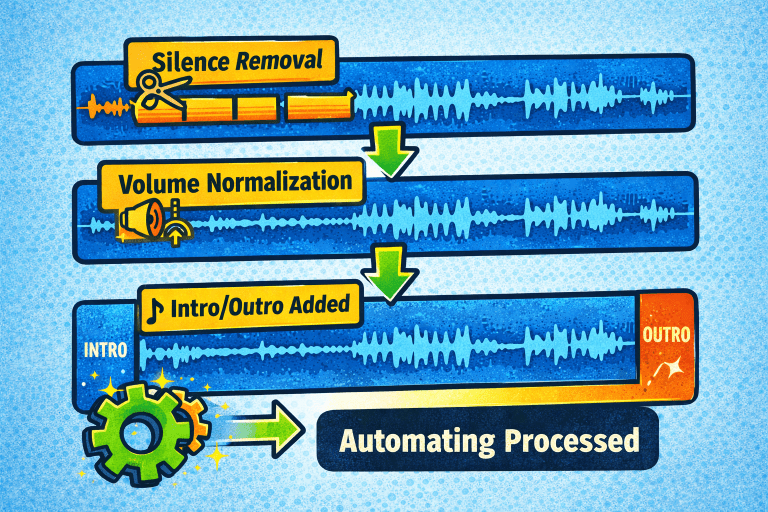
A Real Example: Podcast Editing
While working on my podcast workflow, I automated the editing phase:
- remove silence
- normalize audio
- add intro/outro
- mix background music
This is a perfectly deterministic pipeline.
I could have added AI.
But I didn’t — on purpose.
Instead, I built a small app using standard audio-processing techniques. The result:
- predictable output
- no inference errors
- no API costs
- easy to debug and evolve
AI wasn’t required to solve the problem well.
This Is Not “Anti-AI”
This is about intentional engineering.
AI should be used when it:
- clearly adds value
- reduces complexity instead of increasing it
- solves a problem that rules alone can’t
Sometimes the most professional decision is saying:
“This doesn’t need AI.”
Final Thought
As we head into a new year, my personal rule is simple:
Use AI when the problem demands intelligence — not just because the tool exists.
Part 2 of this reflection will be more technical and aimed directly at developers, with a simple framework / step-by-step guide that I use to decide when AI makes sense.
📚 Resources
This reflection is not based only on my personal experience.
There is growing research, industry reporting, and analysis from very smart people showing that adding AI without a clear justification can introduce cost, risk, and complexity without proportional benefits.
AI-generated code contains more bugs and errors than human output
https://www.techradar.com/pro/security/ai-generated-code-contains-more-bugs-and-errors-than-human-output
Nearly half of all code generated by AI found to contain security flaws
https://www.techradar.com/pro/nearly-half-of-all-code-generated-by-ai-found-to-contain-security-flaws-even-big-llms-affected
AI slows down some experienced software developers, study finds
https://www.reuters.com/business/ai-slows-down-some-experienced-software-developers-study-finds-2025-07-10/
Developer Productivity in 2025: More AI, but Mixed Results
https://thenewstack.io/developer-productivity-in-2025-more-ai-but-mixed-results/
Why 95% of AI pilots fail — and what business leaders should do instead
https://www.forbes.com/sites/andreahill/2025/08/21/why-95-of-ai-pilots-fail-and-what-business-leaders-should-do-instead/
Bias in AI: Examples and 6 Ways to Fix It
https://research.aimultiple.com/ai-bias/
AI trust paradox
https://en.wikipedia.org/wiki/AI_trust_paradox
Echoes of AI: Investigating the Downstream Effects of AI Assistants on Software Maintainability
https://arxiv.org/abs/2507.00788
Replication crisis
https://en.wikipedia.org/wiki/Replication_crisis
Happy coding!
Greetings
El Bruno
More posts in my blog ElBruno.com.
More info in https://beacons.ai/elbruno
 El Bruno
Leave a comment